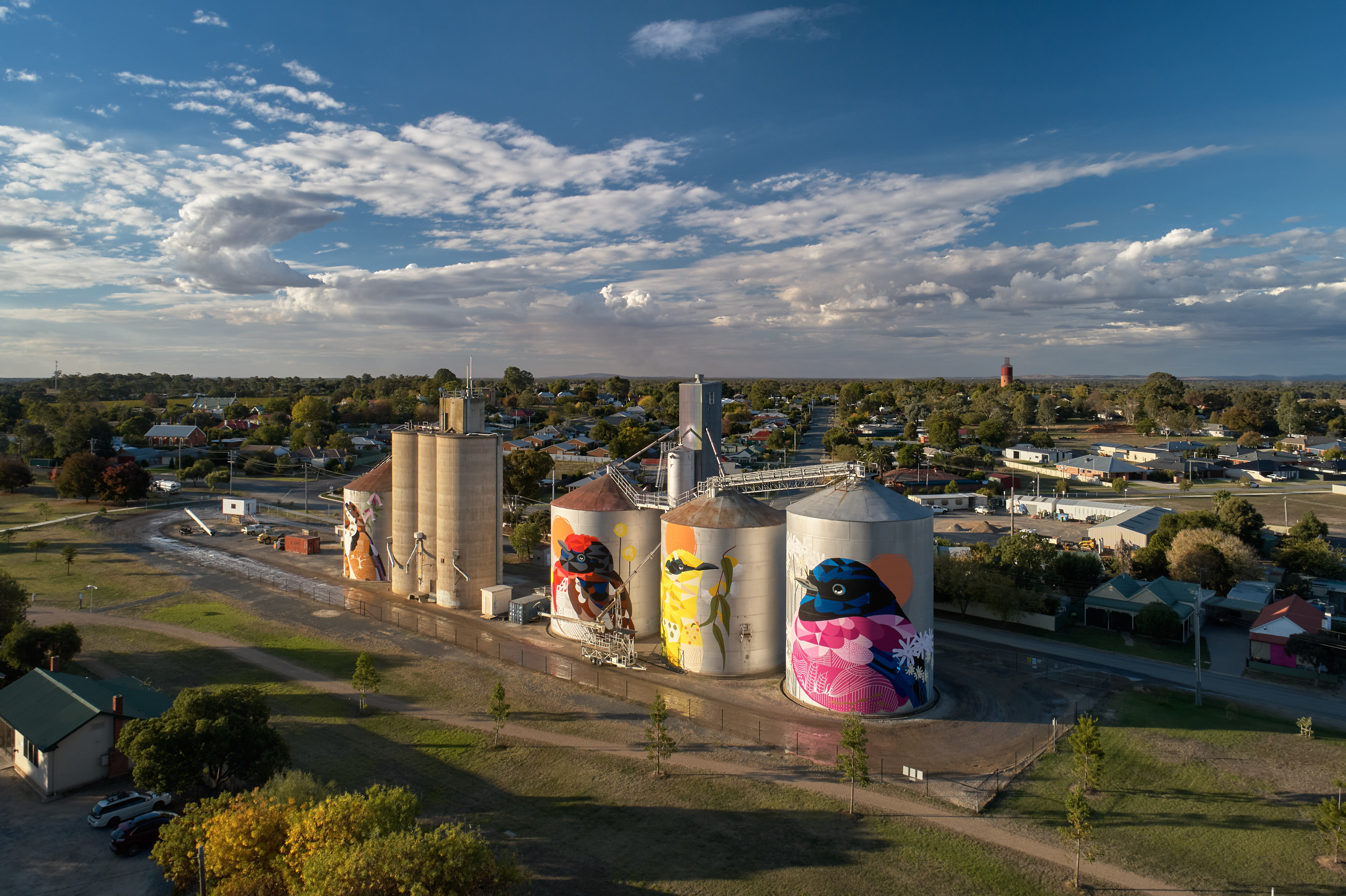
Across Australia, silo art has transformed working agricultural structures into major public artworks, regional landmarks and destinations in their own right. For many projects, the first step is not a formal brief or a confirmed budget. It is often a small group of passionate local people asking a simple question:
Could silo art work for our town?
The answer depends on more than whether there is a suitable silo available. A successful silo art project requires a meaningful local story, genuine community involvement, careful planning and a clear understanding of what the town wants the artwork to achieve. The video below provides a starting point for communities, committees and councils beginning to explore what may be possible.
Why Are Regional Towns Investing in Silo Art?
Silo art can give people a reason to visit a town they may otherwise have driven past.
Griffith University’s Australian Silo Art and Wellbeing research examined the experiences of visitors, residents and local businesses across Australian silo art communities.
Among surveyed visitors:
- 54% said they probably would not otherwise have visited the towns
- 97% recommended that other people visit silo art
- 96% considered silo art a worthwhile investment for regional Australian towns and communities
The study also found that silo art can support community pride, cultural engagement, beautification and a stronger sense of local identity.
These outcomes help explain why silo art has captured the attention of councils, community groups and regional tourism organisations throughout Australia.
However, the research also makes an important point: painting a silo does not automatically create lasting economic or tourism outcomes.
The Artwork Is Only One Part of the Project
A large-scale mural may attract attention, but the experience surrounding it determines whether visitors stop, stay and engage with the broader town.
The Griffith University research found that 44% of surveyed visitors spent between $11 and $50 in each silo art town, while 25% spent between $51 and $100. It also identified practical issues that can limit this spending, including:
- Businesses being closed when visitors arrive
- Outdated or missing information about local opening hours
- Insufficient road and directional signage
- Limited visitor facilities
- Poor connections between the artwork and nearby businesses
- A lack of information explaining the artwork and its local story.
ABC reporting on the research similarly found that silo art may bring people into a town, but additional planning is needed to convert those visits into meaningful local economic activity.
The strongest silo art projects therefore consider the complete visitor experience, not only the painted surface.
- Safe parking and viewing areas
- Interpretive signage
- Links to local businesses and attractions
- Current visitor information
- Accessible pathways
- Opportunities to purchase local products
- Events or activities connected to the artwork
- A plan for ongoing promotion
A Strong Silo Artwork Tells a Genuine Local Story
Silo art is most powerful when the artwork could not simply be placed in any other town.
The Griffith University study identified genuine local storytelling as one of the defining elements of Australian silo art. Visitors and residents expect the artwork to reflect something meaningful about the people, culture, history, environment or identity of the location.
That story does not need to represent every part of the town at once. It does, however, need to feel considered and connected to place.
A strong creative process may explore:
- Significant local people and stories
- First Nations history and living culture
- Agricultural and industrial heritage
- Local flora, fauna and landscapes
- Migration and settlement
- Community achievements
- Present-day identity
- The town’s hopes for its future
The artist’s role is not simply to enlarge a predetermined image. The artist should be able to interpret the project’s themes and transform them into an artwork suited to the scale, shape and surroundings of the silo.
Community Consultation Is Not an Optional Extra
A silo is often one of the most visually prominent structures in a regional landscape. Once painted, the artwork becomes part of the community’s everyday environment.
That makes consultation particularly important.
Griffith University’s research found that residents were less likely to identify with silo artworks where community consultation was limited or where the final artwork lacked a genuine local connection. It also found that consultation and artist-community engagement were central to how people understood successful Australian silo art.
Consultation does not mean asking the entire town to design the mural collectively. That approach can make it difficult for the artist to develop a clear and cohesive artwork.
Instead, consultation should help establish:
- What the town wants the project to achieve
- Which stories and themes are important
- Whether cultural permissions or protocols are required
- Who should be represented in the process
- What concerns need to be understood
- What information the artist needs before developing the concept
The objective is to give the artist a strong and responsible foundation, while still allowing genuine artistic interpretation.
Is the Silo and Surrounding Site Suitable?
Not every prominent structure is immediately ready to become a public artwork.
Before significant fundraising or creative development begins, the physical site should be properly assessed.
Questions may include:
- Who owns the silo?
- Is the owner willing to approve a permanent artwork?
- Is the structure still operational?
- What is the condition of the surface?
- Will cleaning, repairs or priming be required?
- Can elevated work platforms safely access the structure?
- Is the surrounding ground capable of supporting the equipment?
- Are there nearby roads, rail corridors or overhead services?
- Can visitors safely stop and view the finished artwork?
- Who will be responsible for future maintenance?
These matters influence the project’s feasibility, budget, programme and choice of artist.
A useful early concept can quickly become difficult if access, ownership or structural requirements are discovered too late.
What Does a Silo Art Project Actually Involve?
The painting stage is usually the most visible part of the project, but substantial work occurs before an artist arrives on site.
A community newsletter documenting the development of the Quirindi Silo Art Project described more than three years of planning and negotiation before the project reached delivery.
Its preparations included grant funding, local sponsorship, site cleaning, fencing, parking, a viewing area, signage, access equipment, workshops and a planned light show. The artwork itself was expected to take approximately seven weeks to complete.
Depending on the site and project, planning may include:
- Ownership agreements and site permissions
- Project governance
- Fundraising and grant applications
- Community consultation
- Cultural consultation and approvals
- Artist research and selection
- Concept development
- Engineering or structural advice
- Surface testing and preparation
- Access equipment
- Traffic and pedestrian management
- Permits and safety documentation
- Paint and material specifications
- Accommodation and travel
- Photography and video
- Signage and interpretation
- Launch activities
- Long-term maintenance planning
Understanding these requirements early gives the community a more realistic picture of the full project.
Does Silo Art Guarantee More Tourism?
Silo art can create a compelling reason to visit, but it should not be treated as a stand-alone solution to every regional tourism or economic challenge.
Research and real-world examples show that outcomes differ between towns and businesses.
Some communities have experienced increased visitation, stronger local confidence and new business activity. In Thallon, Queensland, community representatives described increases in caravans, spending at local businesses and broader pride following the completion of the town’s silo mural.
Other locations have found that visitors stop briefly, take a photograph and continue driving.
The difference often comes down to what happens around the artwork.
A town is more likely to benefit when it considers:
- How visitors will discover the silo
- Whether they can easily find local businesses
- What else they can do while they are there
- How the project connects with surrounding towns and attractions
- Whether current information is available online
- How the local story is communicated
- What will encourage visitors to stay longer
The mural may create the reason to arrive. The town still needs to create reasons to remain
Could Silo Art Work for Your Town?
There is no single checklist that guarantees a successful silo art project.
A town does not necessarily need to be large, well known or already established as a tourism destination. In fact, part of the appeal of Australian silo art is its connection to smaller communities that visitors may not otherwise encounter.
A useful starting point is to ask:
- Why are we considering silo art?
- What would success look like for our community?
- Does the proposed site have a genuine connection to the town?
- Is there a meaningful local story to explore?
- Who needs to be involved in the conversation?
- What would visitors experience after they arrive?
- Do we understand the complete project, beyond the painting?
- Who will guide the process from the initial idea through to delivery?
The answers do not need to be fully resolved at the beginning.
The important thing is to explore the opportunity carefully before committing the community to a particular artwork, artist, budget or outcome.
Starting the Conversation
Looking to bring art into your project, precinct or place?
We’re always open to new conversations, whether you have a specific silo or site in mind or you are still exploring what may be possible.
To discuss an idea, learn more about the process or explore whether silo art may be suitable for your regional town, contact Mamam:
Phone: (+61) 0433 955 561
Email: contact@mamam.co
Contact: Visit the Mamam contact page
References
This article draws on research, community reports, and published case studies exploring the social, cultural, and economic impact of silo art projects across regional Australia.
- Griffith University. (2021). Australian Silo Art and Wellbeing: First Public Report.
- ABC News. (2021). Silo art attracts visitors but more needed to keep tourist dollars, study finds.
- ABC News. (2022). Oakey swells with pride as street artist Fintan Magee uses library as his latest canvas.
- Quirindi Silo Art Committee. (2022). Community Newsletter, August 2022.